
News
Lac Hong University holds Master Teacher Training 2026 to enhance lecturer capacity
In higher education, training quality is not shaped only by curricula or accreditation systems. It begins in each class session, in the way lecturers ask questions, organise activities, listen to students and assess learning outcomes. A good lecture is not simply one that delivers a large amount of knowledge, but one that helps learners understand, apply what they have learned, think more deeply and develop their competencies after each course.
With this in mind, Lac Hong University organised the “Master Teacher Training 2026” programme, led by the Department of Testing and Quality Assurance. The annual professional training programme is held once a year to support lecturers in improving their teaching capacity, lesson design, learner assessment and teaching improvement in a practical and modern direction.
Master Teacher Training 2026 is not merely a short-term skills training activity. It is part of Lac Hong University’s long-term professional development plan for lecturers, aiming to build a teaching staff capable of designing instruction, organising learning activities, assessing learners and continuously improving lectures. More importantly, the programme contributes to forming a community of lecturers who learn together, share experience and promote an internal culture of quality assurance across the university.
The main participants include new lecturers from faculties and lecturers who have not previously attended the Master Teacher Training programme. These lecturers are entering a structured professional development process and need to be equipped with a foundation in higher education pedagogy, lesson design thinking, methods for organising learning activities and assessment capacity based on learning outcomes. Training this group also helps the university create consistency in teaching orientation, assessment and quality improvement across faculties and academic programmes.
The training team includes Assoc. Prof. Dr. Lam Thanh Hien, President of Lac Hong University; Dr. Nguyen Thi Nhu Quynh, Vice President; Assoc. Prof. Dr. Le Phuong Truong, Head of the Department of Testing and Quality Assurance; Mr. Van Dinh Vy Phuong, M.A., Dean of the Faculty of Information Technology; and Ms. Ngo Dinh Hoang Diem, M.A., Deputy Head of the Department of Testing and Quality Assurance.
The first day of the training programme, held on Thursday, June 25, 2026, marked an important start to the professional development journey of participating lecturers. The session did not focus on theory detached from practice, but on issues closely connected to university classrooms: how to build positive relationships with students; how to set clear learning objectives; how to design activities and assessments aligned with learning outcomes; and how to make lectures more experiential, reflective and applicable.
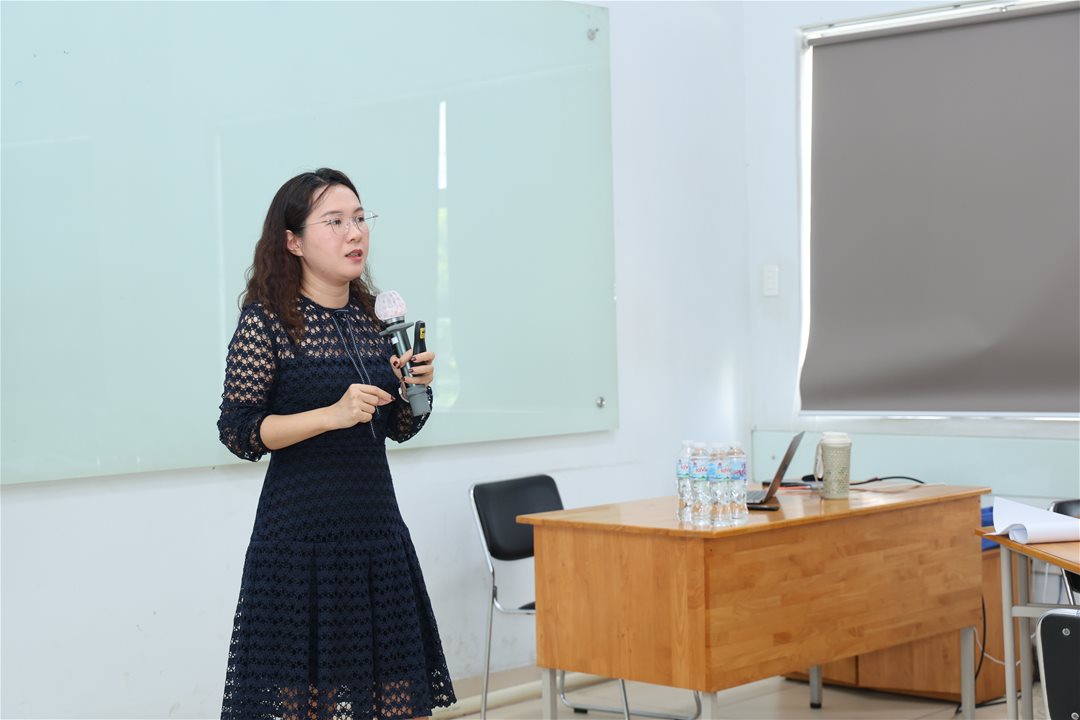
This is an important foundation in pedagogy, as an effective classroom is shaped not only by lesson plans, learning materials or assessment methods, but also by the way lecturers build trust, respect and connection with learners. Before students can become active learners, they need to feel respected, heard and encouraged to participate. Lecturers’ empathy, two-way communication, positive feedback, clear expectations and timely academic support all contribute to creating a safe, open and responsible learning environment.
.jpg)
In the next session, Assoc. Prof. Dr. Le Phuong Truong led two key professional topics: “Applying Bloom’s Taxonomy in designing learning activities and assessment” and “Designing teaching and assessment plans based on learning outcomes – OBE.”
With Bloom’s Taxonomy, lecturers were introduced to ways of designing learning objectives, questions, learning tasks and assessment tools according to different cognitive levels: remembering, understanding, applying, analysing, evaluating and creating. Bloom helps lecturers reflect on their lessons: are students merely recalling knowledge, or do they have opportunities to apply, analyse, compare, evaluate and create new learning products? Instead of only asking students to “state a concept,” lecturers can assign tasks that require them to analyse a situation, select an appropriate solution, evaluate an approach or design a product linked to the course content.
With outcome-based education (OBE), lecturers approached instructional design by beginning with a fundamental question: “What should learners be able to do after this course?” From there, learning outcomes, teaching activities and assessment methods need to be aligned. If a learning outcome requires students to analyse, design or propose solutions, then lessons and assessments should not stop at memorisation or simple knowledge presentation. This is a core element of programme quality assurance, as learning outcomes are meaningful only when they are translated into specific classroom activities and measured through appropriate assessment methods.
.jpg)
The session continued with a presentation by Ms. Ngo Dinh Hoang Diem on applying Kolb’s experiential learning model in lesson design. Kolb’s model includes four stages: concrete experience, reflective observation, abstract conceptualisation, and experimentation or application. In simple terms, students learn better when they are able to do something, reflect on what they have done, draw lessons from it and apply those lessons to new situations.
In university classrooms, lecturers can apply Kolb’s model through activities such as case studies, small projects, group work, simulations, reflective discussions, learning journals or end-of-session learning products. When designed appropriately, these activities make lectures less one-way, increase student participation and connect course content with practical competencies.
.jpg)
After the training, lecturers are expected not only to better understand Bloom, OBE and Kolb, but also to apply these approaches in their teaching plans, learning activities and assessment methods.
Through Master Teacher Training 2026, the role of the Department of Testing and Quality Assurance is further demonstrated through its close support for lecturers. The department is not only responsible for testing, accreditation and quality monitoring, but also works with lecturers to improve teaching through specific actions: writing clearer learning outcomes, designing more suitable learning activities, developing assessments that better reflect learner competencies, and gradually developing digital learning materials while effectively applying digital technologies and artificial intelligence in teaching.
.jpg)
The first session of Master Teacher Training 2026 was therefore more than a professional training activity. It marked the beginning of a continuous professional development journey for lecturers at Lac Hong University. When each lecturer actively renews their lectures, pays greater attention to students’ learning experiences and assesses learner competencies more accurately, training quality will be improved from everyday classrooms.
training course # Bloom # Kolb # OBE learning outcomes # teaching # professional development
